Author Archives: Dean Allen

Unknown's avatar

About Dean Allen

Six continents in ten months! For much of 2014 and 2015, I shared a family sabbatical with my wife, son, and daughter. During Summer 2019, we took another round-the-world trip. I learned that I was at home while traveling. In this blog, I have described some of our experiences and the lessons we learned traveling the world. You will see my (Dean's) reflections at LDeanAllen.com and my daughter, Rachel's, reflections at RachelSeesTheWorld.wordpress.com. Now, we are at home. I (Dean) am a professor at Northwest Florida State College, and I encourage students to find the good life. My teaching is informed and enriched by my travel. I also serve as pastor of a congregation, seeking to foster a community in which people live their lives with deep meaning, fullness, and joy.

Whales and Seals in South Africa

Shortly after we arrived in the Western Cape of South Africa, we were told that we may be able to see whales during our stay.  The Southern Right Whale spends summer feeding near Antarctica and migrates north in winter for breeding.  September marks the end of winter in South Africa, and we have seen signs of spring all around.

A couple of days after arriving in Yzerfontein, South Africa (the beautiful seaside town that is our home for the month of September), my wife and daughter were enjoying time on the beach, when they spotted something near the town’s dock.  At first, my wife thought it was a rock, but on closer inspection, they saw that it was a whale.  They sped home to gather my son and me, and the four of us went to the dock.  We spent the next forty-five minutes transfixed by the whales.  There were three whales within fifty meters of the dock, and they appeared to be two large adults and one small young whale.  We could see another whale about three hundred meters away.  They seemed to float effortlessly, rising and falling with the waves.  Their mouths came out of the water, and they occasionally fluttered their fins and tails.  It was a sight to behold!Whale
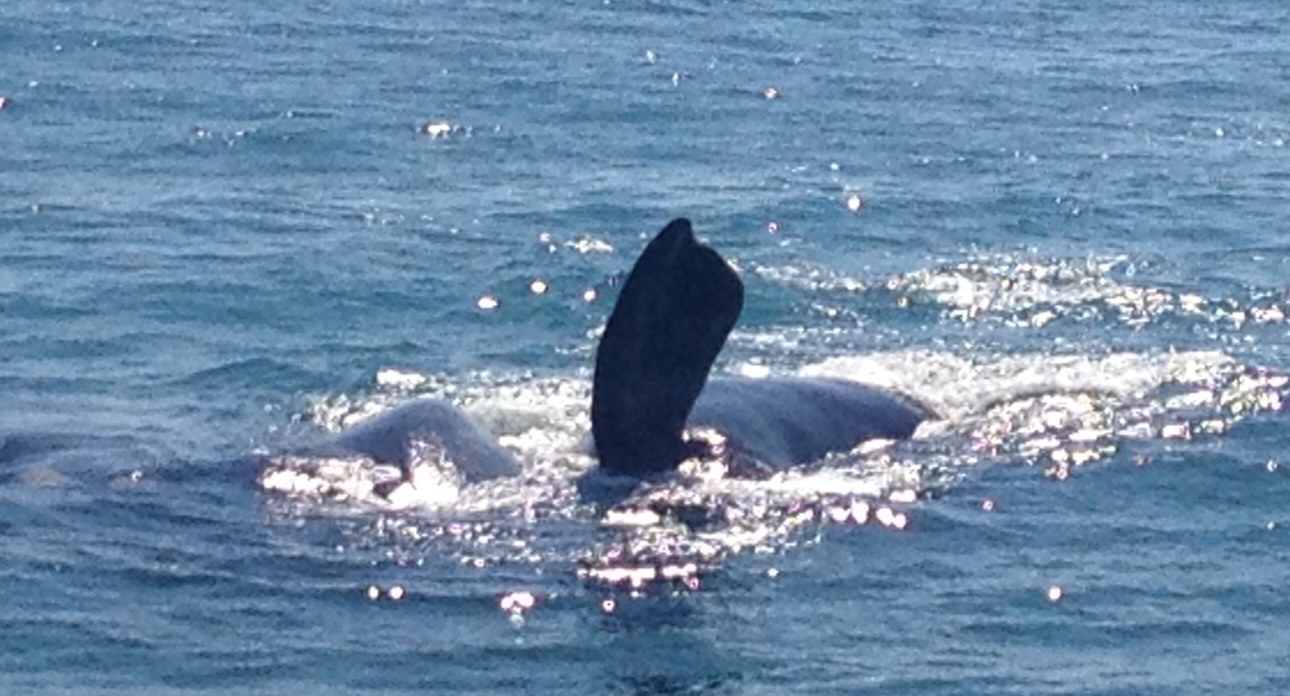
We have seen whales on two other occasions.  Once was while at the West Coast National Park, a beautiful place set on the coast just north of Yzerforntein.  And the second time was from the beach while walking the dogs. A storm was brewing, the winds were strong, and the seas rough. Just off shore — no more than 200 meters — we spotted a whale easily floating in the water. It seemed to take no mind to the storm that was leaving us damp and windblown. And we didn’t mind the cold and damp conditions as we watched this majestic creature.
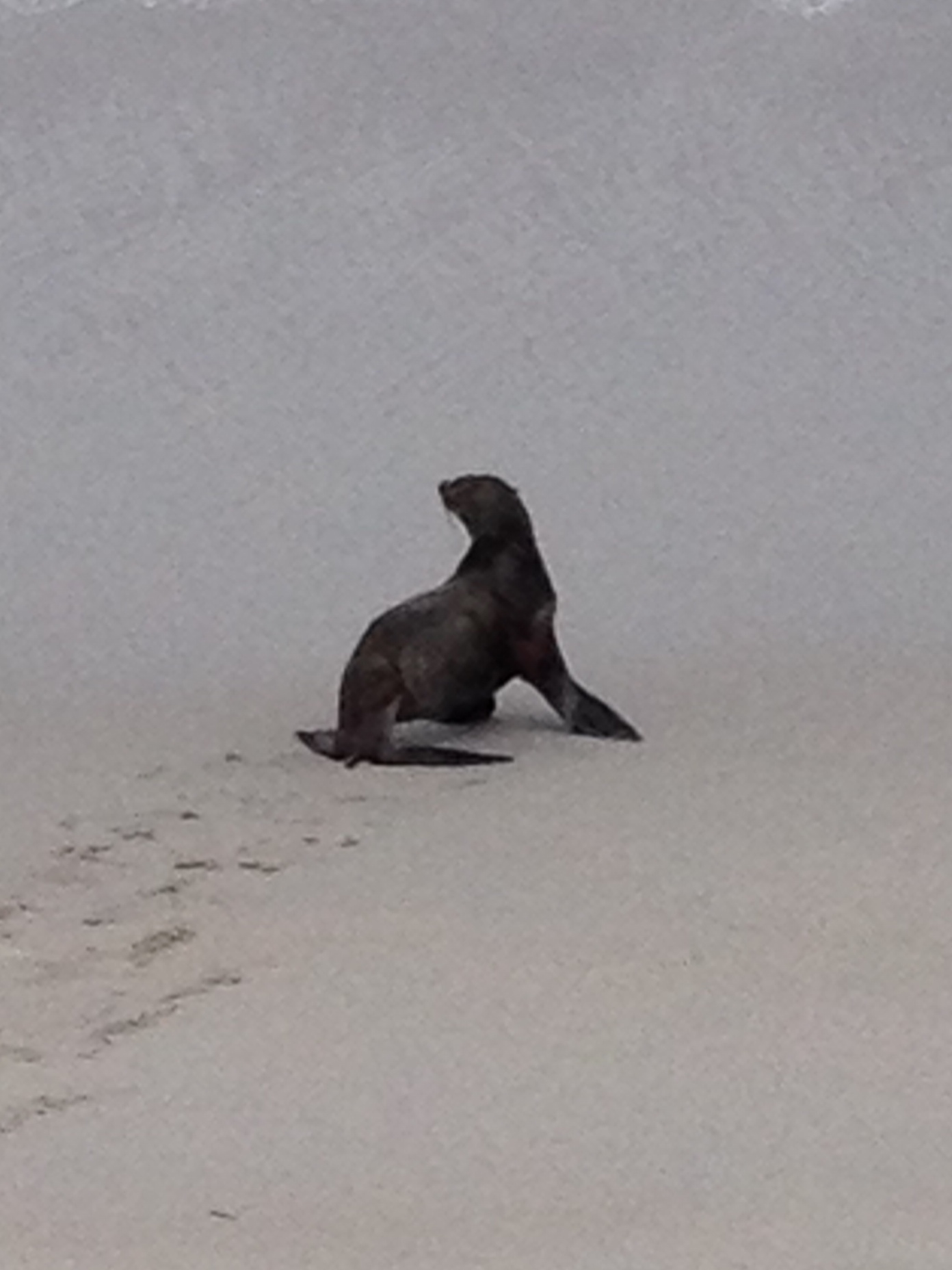
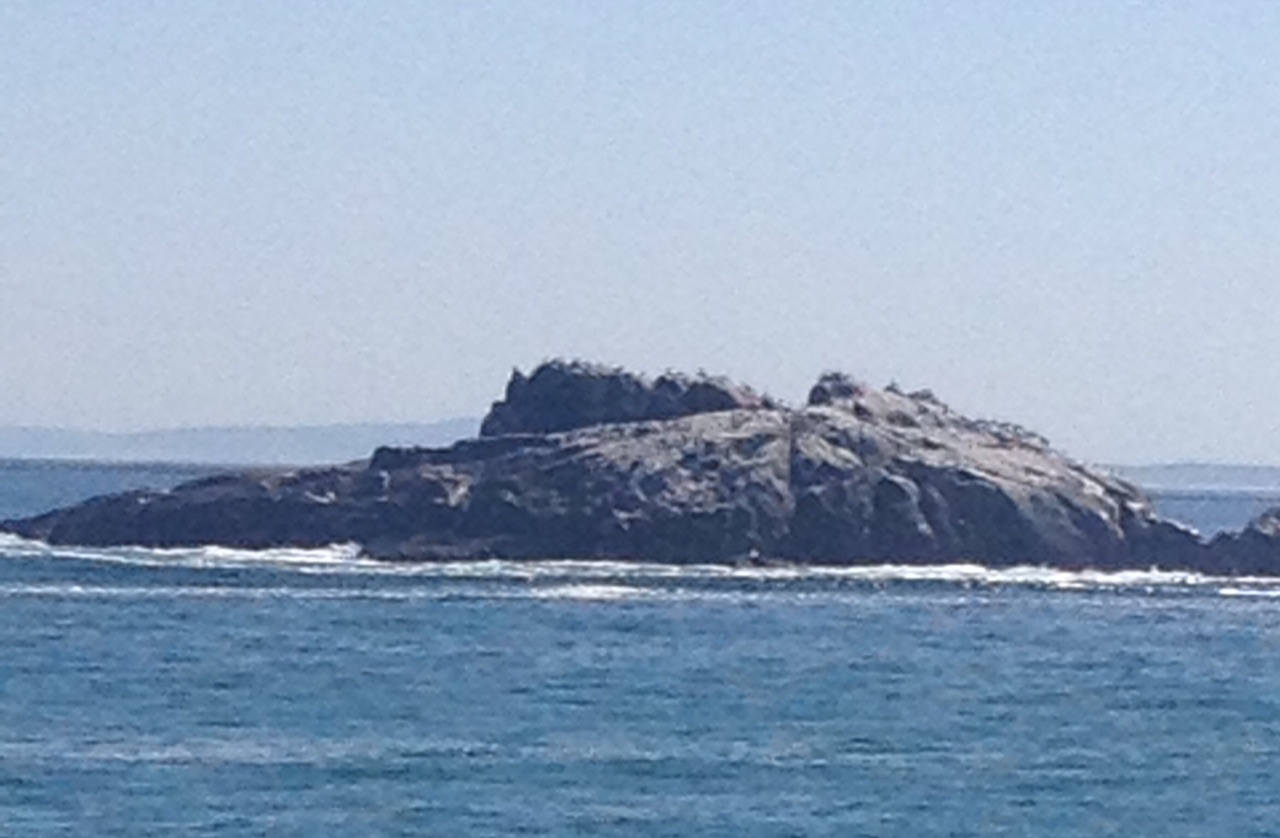
SealIn addition to whales, I also hoped to spot some seals while in South Africa. We traveled to Robben Island (more about this experience in another blog post), which is named for the seals in the waters near Cape Town. Robben is the Dutch word for seal. As our boat approached the island, we saw eight or ten seals sunning on rocks. It was a nice sight, but I really was hoping to see seals in a more natural setting.

Yesterday, while my daughter and I were walking the dog on the beach, we looked behind us, and we saw a seal on the shore. We stood still for several minutes watching the seal. With Pella the dog securely on the leash, we walked closer to get a better view. As we approached slowly, the seal looked at us for a while before walking into the surf. It started swimming in the water just a few feet offshore. As we walked back home, the seal swam parallel to the shore in the same direction we walked. What a gift in this wonderful town! Seal 2

Isepho Means “Gift”

After a wonderful time in South America, we made our way across the Atlantic Ocean to South Africa. During the month of September, we are staying in Yzerfontein, South Africa, which is about one-and-a-half hours drive north of Cape Town on the western coast. It is a beautiful setting on the ocean, and the combination of white sands, brown rocks, and large waves is breathtaking. (The scenery here is very similar to the California coast near Monterey and Carmel, one of the most beautiful spots on earth.)Rock

We are staying in a wonderful home named Isepho, which means “gift” in the local language. Truly, it is a gift to be here. (If you are interested in staying here yourself, you may book a reservation through AirBnB.com.)

We found our way here thanks to MindMyHouse.com, a house sitting website that connects prospective sitters with homeowners who need help when they are away. Our duties include walking the Labrador Retrievers (Biscuit and Pella) and caring for the cat, Magwa. All three animals are wonderful, loving creatures. They greet us warmly each morning, and Magwa the Cat sits in my lap as I drink coffee on the back deck while watching and listening to the surf.

On the beach with Pella

On the beach with Pella

Our gracious hostess, Claire, met us at the airport, treated us to ice cream on our way home, introduced us to people around the town, fed us dinner, and trusted us with her automobile while she is away. Yes, I am driving a manual transmission on the left-hand side of the road. All of this is a gift indeed!

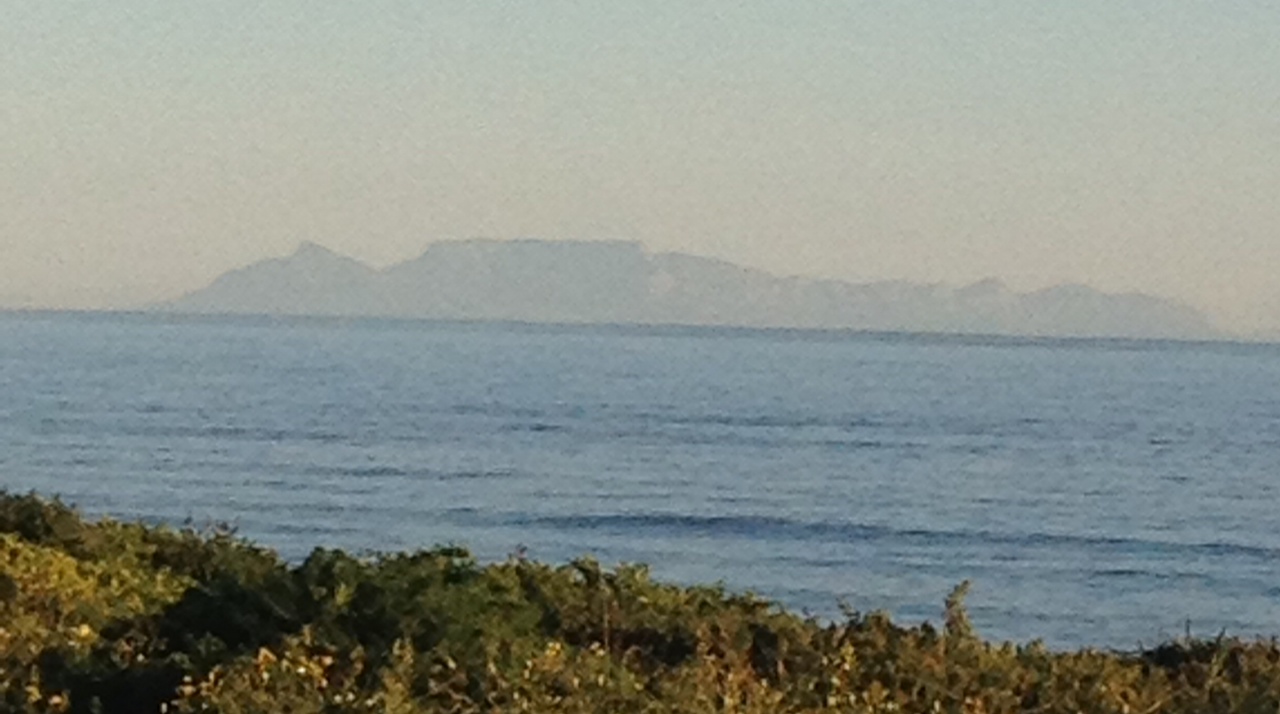
Table MountainIt is winter here, and temperatures range from about 10 degrees Celsius to 21 degrees Celsius (that’s roughly 50-72 degrees Fahrenheit). Days have been sunny and beautiful. We can see Table Mountain in Cape Town as we look south down the coast. And to the north is West Coast National Park with its vibrant display of wildflowers this time of year. People across South Africa travel to this area this time of year to view the flowers much like people in the States travel to New England to see Fall Foliage.

In the coming days, we will explore the area. We plan to walk on the beach every day, see the wildflowers, and travel to Cape Town where we will visit Robben Island, Table Mountain, and other sights in that wonderful city.

For now, we are enjoying Isepho, the gift we are fortunate to share for this month.

Yzerfontein, South Africa

Yzerfontein, South Africa

Noisy Afternoon and Quiet Day in Buenos Aires

I’m waiting in the Buenos Aires airport because our departing flight is delayed until midnight by an air traffic control strike. This is part of a general strike that has been called today across much of Argentina.

Yesterday, we spent many hours walking around this wonderful city. After passing La Casa Rosada, the Pink House that houses Argentina’s presidential offices and which was made famous by Eva Peron’s speeches from the building’s balcony and, perhaps more famous, by Madonna’s portrayal of her in Evita, we heard beating drums, fire crackers, and chanting marchers. Workers took to the streets to voice displeasure with their working and living conditions.

What a civics lesson for our children and for my wife and me! In our regular, suburban life, we usually are far removed from such a demonstration and the plight of the workers who marched. It provided opportunity to talk about the situation faced by many people in the world.

Wave after wave filled the street. Some were boisterous young men in their public uniforms while others were young women walking quietly with children.

Today, Buenos Aires’ streets were quiet and nearly deserted as the general strike commenced. We rode the Subte, and rather than buzzing with commuters, we were some of the few people underground on the train.

Thankfully for us, the workers at Parrilla Pena came to work today because we loved the delicious lunch we ate there. The empanadas, beef tenderloin, and Rib Eye steak for which Argentina understandably is well known were outstanding.

By the time the taxi driver brought us to the airport, more people were on the streets, but I suspect today was calm and quiet compared to the beating pulse that usually greets guests in this city.

Now, we have a bit more time at EZE airport, which is extremely comfortable with free Wi-Fi and nice seats for passengers. If we have to be delayed, this is a good place to be!

Our visit to Buenos Aires was wonderful, and I hope to return someday. I’ll look forward to it, whether it is noisy or quiet.

IMG_1734-0.JPG

IMG_1762.JPG

Machu Picchu: “It fairly took my breath away”

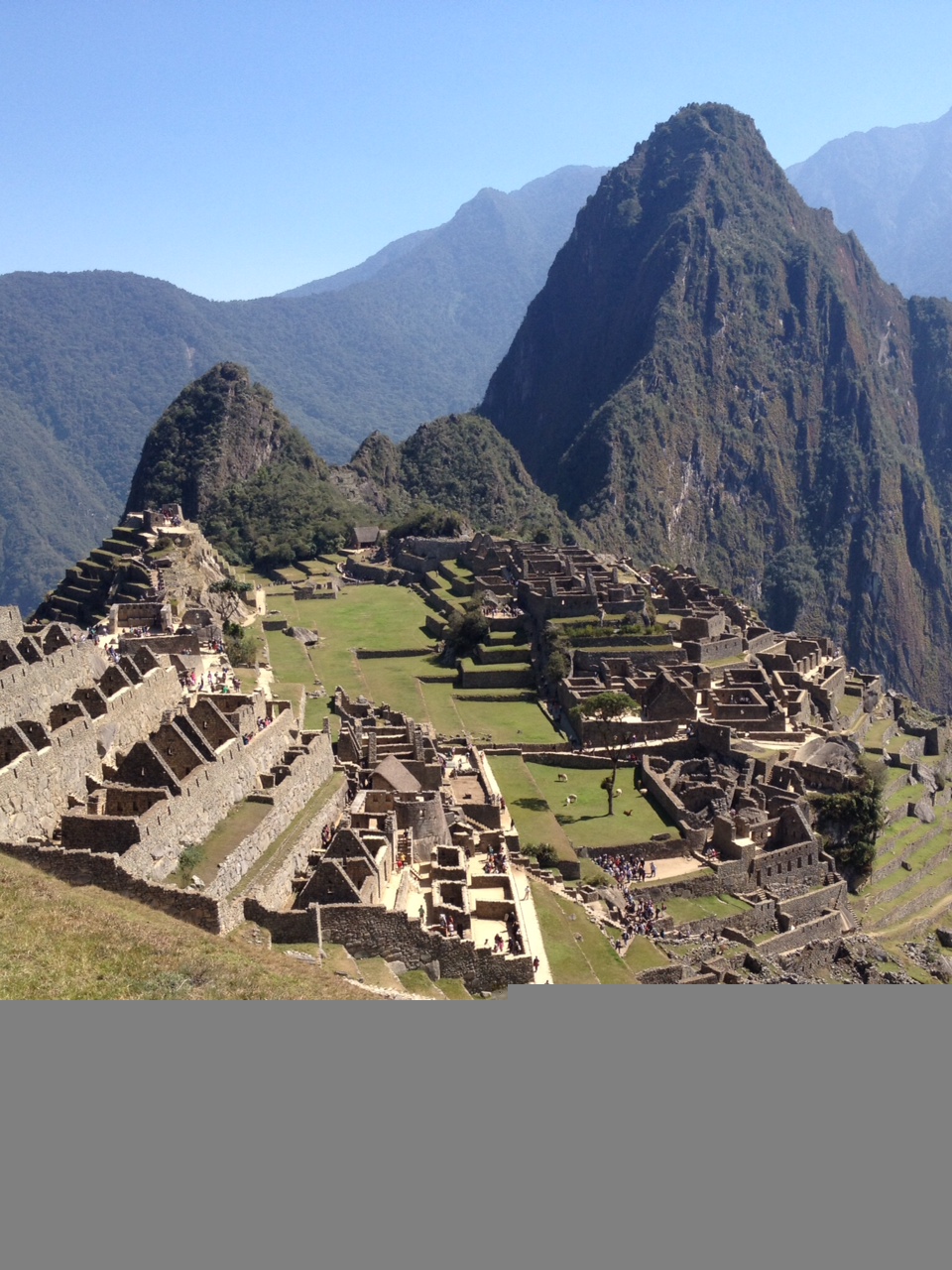
Machu PicchuWhen Hiram Bingham described experiencing Machu Picchu for the first time in 1911, he said, “It fairly took my breath away.”  I echo his sentiment.  While our family’s journey was much easier than Bingham’s thanks to the PeruRail train from Cusco, Peru, to Aguas Calientes (the town at the foot of Machu Picchu) and the bus that carried us up the mountainside, I still found myself drawing a deep breath in awe when I saw Machu Picchu for the first time.

The trip from Cusco to Aguas Calientes on a PeruRail Vistadome train was wonderful.  I spent the three and a half hours looking out the window at the amazing Andes mountains as well as farmers working in fields and animals grazing along the route.  To my surprise, we were served a delicious breakfast.  It was a wonderful ride, which I highly recommend.

In Aguas Calientes, we were greeted warmly by Carlos at our hostel.  We had a relaxing day to prepare for our trip to Machu Picchu.  Then, after riding our bus up the switchback road to Machu Picchu, we made our way through the entrance and walked to the site.  I kept telling myself to keep my expectations low.  “Sure, I bet it’s pretty,” I thought, “but don’t expect too much or you’ll be disappointed.”  When I caught my first glimpse of the site, I found myself in awe.  No hint of disappointment.

The setting is incredible with high Andean peaks all around, sheer drop-offs of 1,000 feet or more to the Urubamba River below, and amazing stone work at the complex.  My mind was filled with many questions:  how did they build this?, how much effort was involved?, how difficult was it to leave this behind?.

To prepare for my trip, I read an excellent book:  Turn Right at Machu Picchu, by Mark Adams.  Adams weaves a description of his own trek in Peru following in Bingham’s footsteps with Bingham’s experience a century earlier.  It is a fun read, and it provides excellent insight into Bingham and others who have tried to explain why Machu Picchu was built and its place in Inca culture.

I also thought of other friends from back home who had completed their own trek on the Inca Trail.

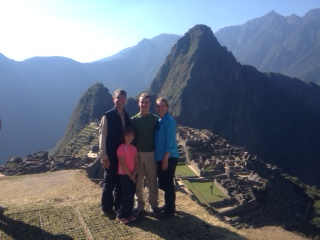
Our family enjoyed a walk from Machu Picchu to the Inca Bridge, which includes narrow paths without guard rails and steep drops to the river below.  We walked through the ruins, looking at the stone work, imagining Machu Picchu when it was active and alive, and reading interpretations of Inca culture.  We reflected on the people who built and inhabited this place more than five centuries ago.photo-1

But mostly, I found myself staring at the site, almost mesmerized by its beauty and immensity.  Indeed, “it fairly took my breath away.”

Playing Games and Spending Time with One Another

One of our goals in going on our family sabbatical is to leave behind — at least for a while — the routines and distractions that so often tend to fill our lives.

Staying in hostels these past couple of weeks, we have had no access to television and only limited Internet. This has provided us many chances to play games with one another, something we rarely do at home. (One exception to this is the almost daily Yahtzee games we play while visiting with my In-laws. My mother-in-law is known as the Yahtzee Queen because of her many years of success! I aspire to such greatness, but I am not even close to being a Yahtzee Prince.)

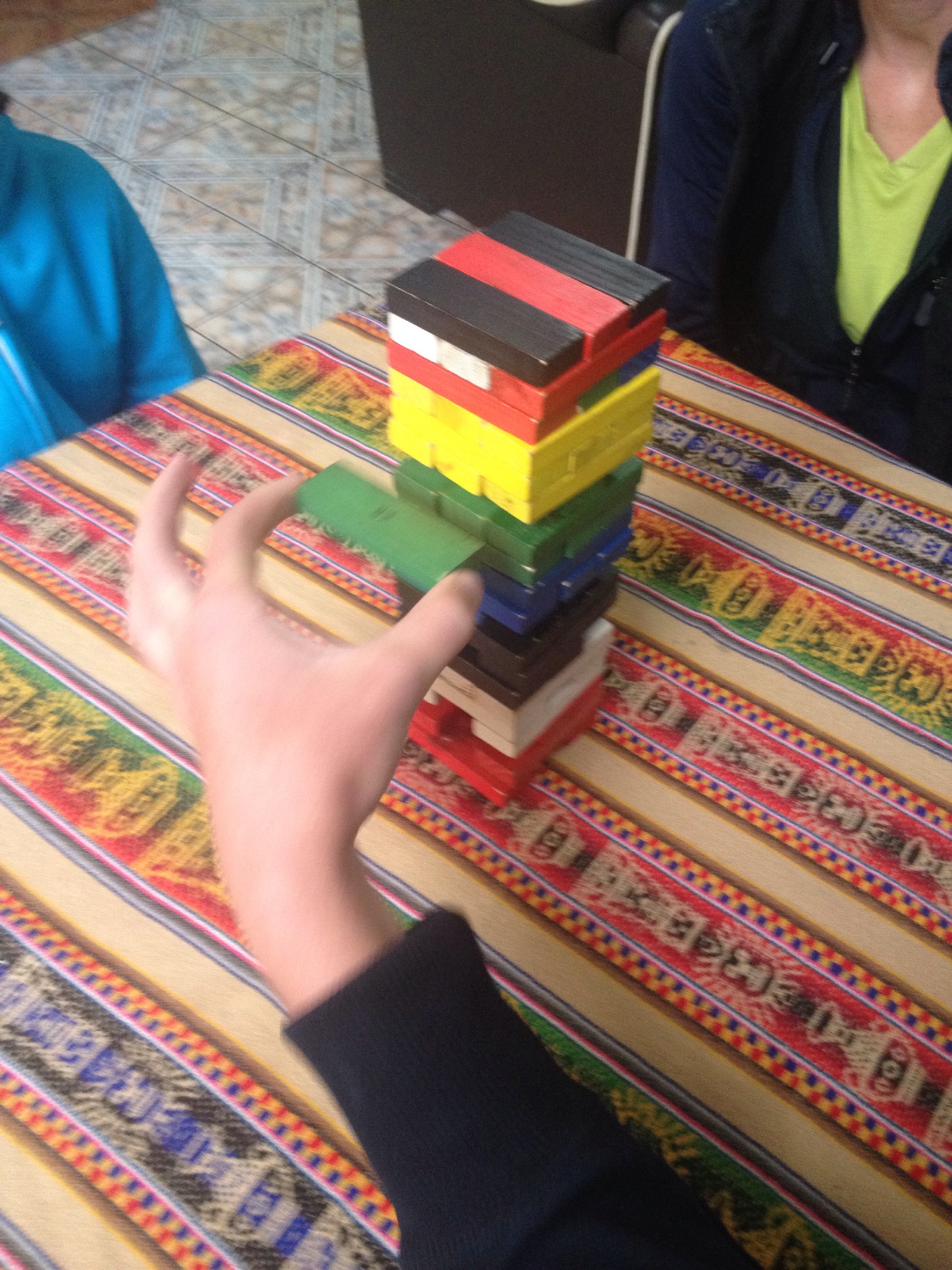
As I’m writing this blog entry, I have just been eliminated from a family Jenga tournament. The tower just crashed as I was pulling out a block.

The other three members of our family are still competing for the coveted title of Jenga Champion. They each are pulling blocks from the tower and hoping it won’t crash down.

We also have a deck of Uno cards with us at all times. Yesterday, we played several games of Uno on a grassy overlook at Machu Picchu. Last summer, we enjoyed playing Uno on the Eiffel Tower and the Chunnel train.

It’s curious that we have travelled thousands of miles to play games with one another, but it is a wonderful aspect of our traveling together.

Now, I’ll begin to plot my strategy for the next Jenga tournament…

IMG_1717.JPG

Cusco, Peru

We traveled from Manaus, Brazil, to Cusco, Peru, via flights through São Paulo and Lima. Arriving in Lima near midnight, we joined the crowds sleeping in the airport. Our two children were wonderful about this part of our adventure!

We left 100 degrees Fahrenheit temperatures in Manaus. As we descended over the Andes into Cusco, the pilot announced that the current temperature was zero degrees Celsius, which is 32 Fahrenheit. What a change!

Today, the city of Cusco, with its 450,000 residents is best known to outsiders as the gateway to Machu Licchu and the Sacred Valley. Two million tourists come to the city each year, and like most of them, we will head to Machu Picchu after spending two days in Cusco to acclimatize to the altitude.

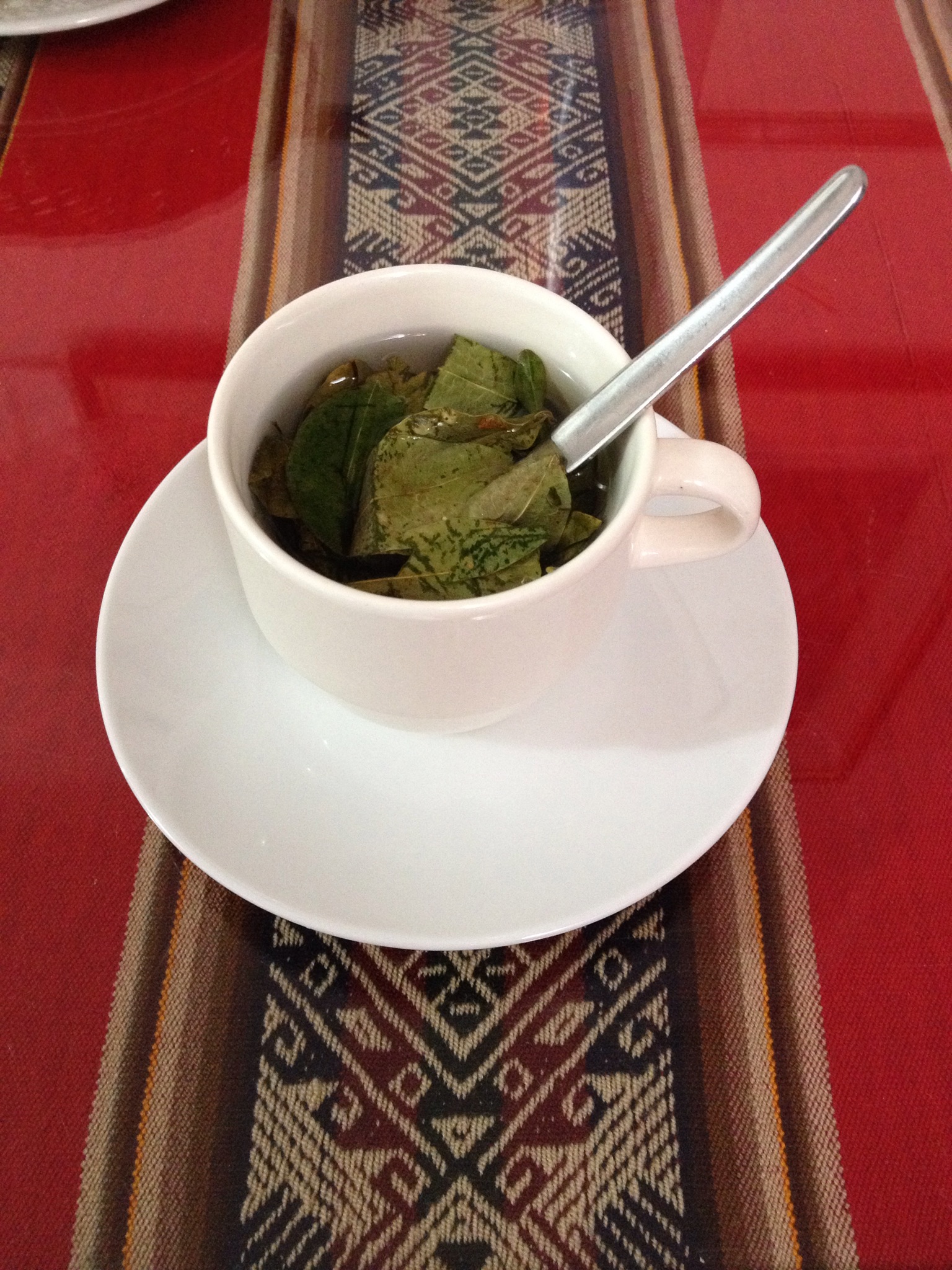
The city’s elevation is 3399 meters (more than 11,000 feet), and some visitors have symptoms of altitude sickness. Visitors are encouraged to drink lots of fluid and take it easy for a day or two. Many visitors also drink mate de coca (coca tea), which is an herbal infusion of leaves from the coca plant – yes, the coca plant from which alkaloids are extracted to make cocaine.

Our hostel keeps hot water and dried coca leaves out for guests at all times. We have consumed our share of mate de coca as an extra step to stave off altitude sickness.

Our hostel is on the Plaza de Armas, and it looks onto the Spanish-style plaza that is filled with school children in uniforms, locals selling their wares, dogs playing, visitors enjoying the scene, and traffic police helping cars and pedestrians live in harmony.

The scene is pretty, the sunshine bright, the temperature cool, and our family happy. This is a great place to be as we prepare to visit Machu Picchu later this week.

IMG_1642.JPG

A long, hot day

It began with the promise of being an easy day. We had returned the previous night from our jungle tour in the Amazon. Our one real goal for the day was to wash clothes.

At home, of course, this would be simple. We would throw the dirty clothes into the washing machine, add detergent, and go about our other business returning in an hour to find clean clothes. It was not so easy for us in Manaus, Brazil.

The hostel had no washing machines for guests. There was no self-service laundromat nearby. I went to a drop-off laundry store and in broken Portugese (helped by a translating app), I learned that they may not be able to get our clothes washed in one day. So, we decided to hand wash.

We have done this numerous times while traveling. But on this day, the temperature was around 100 degrees Fahrenheit, the humidity was high, and our energy still was low after our trip to the Amazon. The four of washed our mound of clothes one piece at a time in a sink. After wringing each piece in a towel that quickly became soaked, we hung our clothes on twine we brought from home and tied up in a courtyard at the hostel.

We felt sweat running down our backs and legs, on our foreheads, and above our lips. It was a type of hard work that we usually don’t face thanks to our automated washers.

Later, while going to a market to get good to fix for dinner, I saw laundry hanging from apartment windows and on balconies that others had washed that day just as we had done. It was a stark reminder of the challenges many people face everyday.

Our sweat eventually dried, our clothes eventually were clean, we got showers in cool water, and we went to bed. We travel next to Peru where temperatures and humidity will be much lower.

In the Amazon

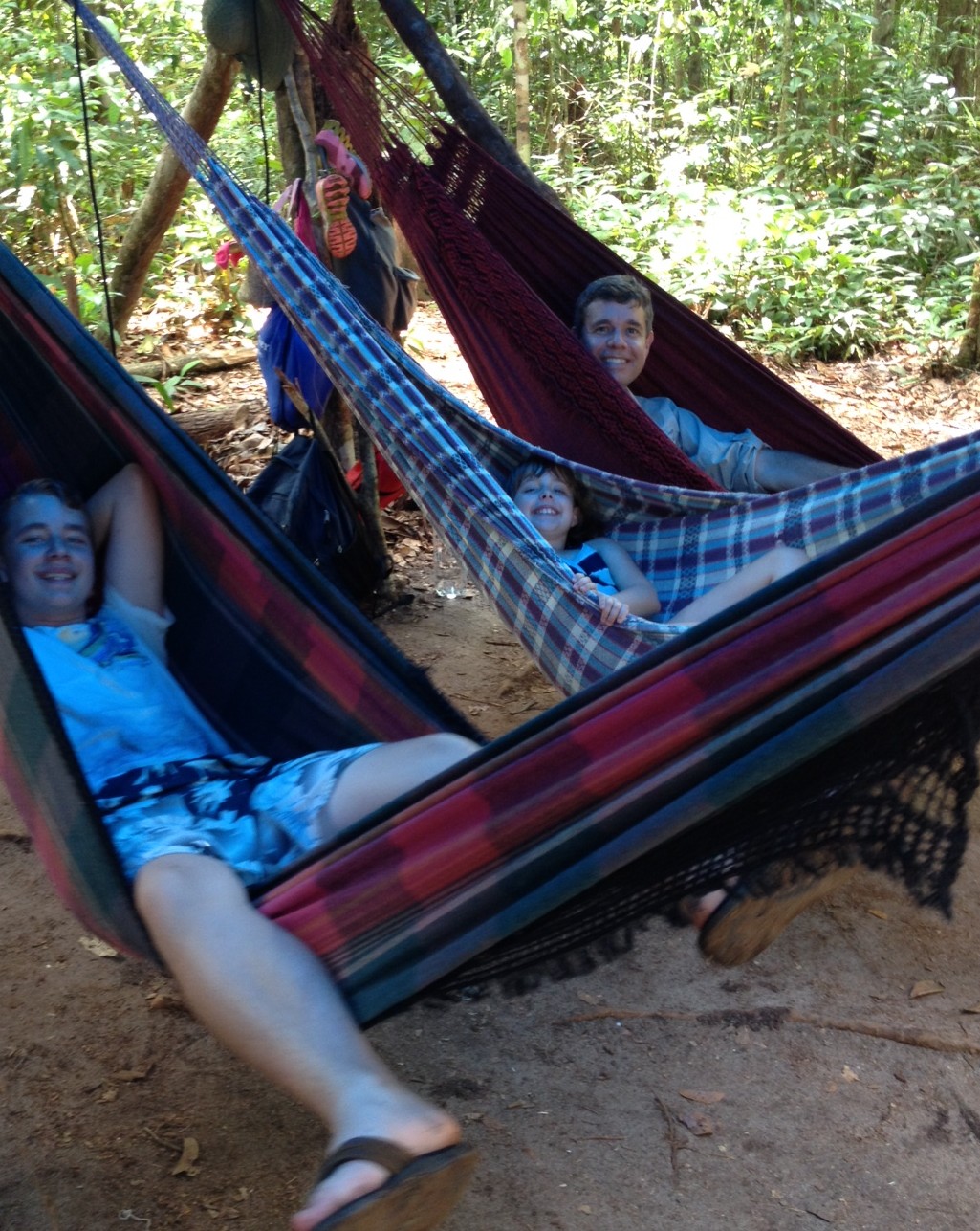
Hammocks in the AmazonWe had a great time exploring the Amazon Rainforest. We were the only Americans in an excellent group of fourteen people. We shared wonderful time with a Dutch couple, Neils and Nina, one Spanish young woman, and seven French students. They graciously spoke with us in English and helped us with our halting attempts to speak Spanish or French. Our guide, Christopher, is a native of Peru, but has lived for many years in the Amazon.

We drove three hours north or Manaus, Brazil, and then rode in a boat along the Urubu River for nearly an hour to reach our camp. (See http://www.antonio-jungletours.com.)

We rode in canoes along the river, and I caught a piranha. The cook fried it and added it to our dinner that night. Later, we rode in our canoe to find a caiman (a relative of the alligator). Shining his flashlight into the darkness, Christopher saw the animal’s red eyes reflecting back at us. He carefully caught the creature, and then allowed each of us to hold it.

We spent the night in hammocks, which we carried during our trek along with all other supplies. Our lunch and dinner — chicken, sausage, and rice — were cooked over an open fire. Our breakfast — coffee with boiled eggs — also was cooked over the fire.

We know why it is called a rain forest because it rained three times while were trekking. Thankfully, the camp had tarps, which protected us from getting wet (mostly).

We saw many animals along the way: monkeys, a viper, a tarantula spider, numerous insects, and countless birds. We saw beautiful flora and learned how native people have used these plants for medicine and food through the centuries.

Other highlights included watching grey and pink dolphins in the river and visiting with a local family that makes its way by farming the land. During our visit, we saw the anaconda that they caught while it was trying to catch their chickens. None of us held it!

It was hot and humid, and our bodies were covered in sweat during our long walks of three-plus hours and our rides on the river. We returned tired from our activities. But, it was a wonderful experience that we will remember for years to come.

First Day in Brazil

We arrived in Brazil late on Tuesday, August 12, made our way to our hostel, and got to sleep a bit after midnight. The city of Manaus was quiet as we rode from the airport, passing the futbol stadium where World Cup games were played just a few weeks ago.

This morning, the city was alive and active. After breakfast, we walked around town with shopkeepers opening their stalls, uniformed children making their way to school, and commuters going to work on city buses.

Now, taking a break from the afternoon heat, we are resting before venturing out again to find food for dinner.

A very good day.

Tomorrow, we depart for our Amazon tour. www.antonio-jungletours.com.

IMG_1616.JPG

IMG_1621.JPG

Go Without Reservation

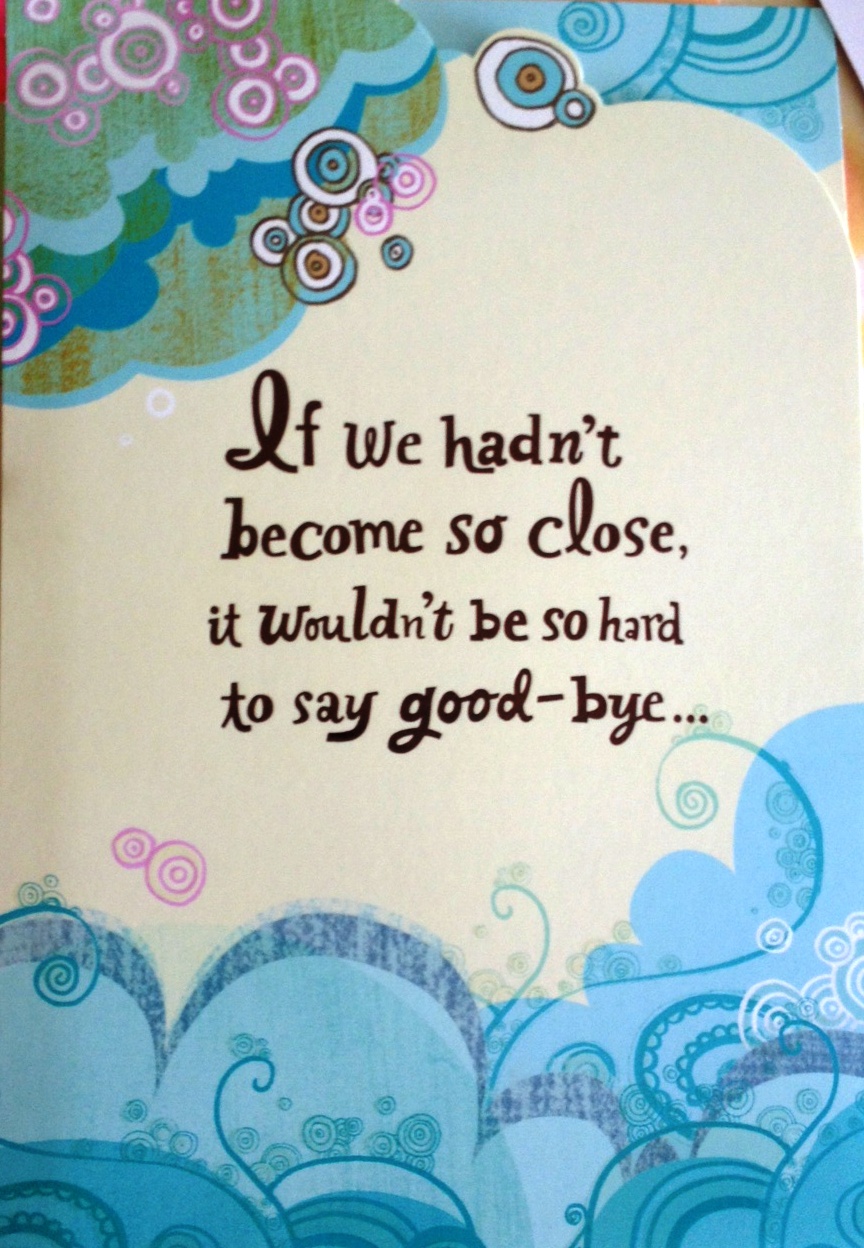
I have written about our family’s departure from the church we served and the town we loved in recent posts.  Many friends gave us cards and special notes as we were leaving, and one friend wrote a beautiful poem about our time together.  

We treasure these notes and cards because they remind us of the ties we share and the good wishes that accompany us on our journey.

One of many cards shared with us.

One of many cards shared with us.

One friend’s note gave specific examples of what our relationship had meant, and this friend then blessed us in our departure, saying, “Go without reservation.”

What a gift to be blessed by someone in this way.

On August 12, we depart for South America as we commence our family sabbatical.  Our journey will take us first to Manaus, Brazil, where we will explore the Amazon.  Then, it’s on to Machu Picchu in Peru and Buenos Aires, Argentina.  We will settle for a month while house-sitting in Cape Town, South Africa, before exploring Zambia and Botswana.

We expect to see many new things, to encounter many wonderful people, to taste new foods, to encounter difficult challenges, and to learn about history and culture in places of the world we have only read about.  

Most of all, I am looking forward to the growth and learning that will happen internally — for me and for our family.

I believe that travelling to new places where the language and customs are unfamiliar to us will force us to rely on the goodness of others and draw on creativity and resourcefulness that will force us to grow and develop in new ways.

After months of planning, the adventure begins on August 12.  And now, thanks to a dear friend’s reminder, we will go without reservation.